Category: Blog Post

  • You Can’t Afford to Wait

    In today’s modern media landscape where information moves quickly, you can’t afford delays in finding out about breaking news that impacts your brand or bottom line. Having the latest information in hand in real-time is vital to respond, correct the record, and shape the coverage as it happens.

    Recently, one of BSG’s clients prepared for a federal agency to release a new rule that would have a significant impact on its business. On the day of the release, by way of our advanced tech stack, we were able to alert our client to the announcement almost instantaneously. Had the company relied on the federal agency’s email alert service, they would have waited 40 minutes from when the news actually broke. In those 40 minutes, nearly a dozen publications published stories on the rule, and two different government entities posted press releases in response.

    Bullpen Strategy Group has the team and resources to alert our clients to breaking news when it happens.

    Get in touch at contact@bullpenstrategygroup.com to learn more about our range of Media Intelligence service offerings.

  • After The Bell: How BSG Media Intelligence Helps Manage Earnings Day

    If you work for or with publicly traded companies, you know that four times a year, earnings reporting means absolutely everything happens all at once. With the Fourth Quarter 2023 earnings season now nearly over, it’s a good time to reflect on the vital importance of how these announcements are managed.

    From communications teams handling incoming media requests and correcting the record, to Investor Relations teams shaping the narrative, to C-Suite media engagements – what the media says, and how they say it in those crucial moments after the bell have great impact on your bottom line.

    The last thing anyone wants to worry about as they confront these challenges is the mundane task of capturing, analyzing, and distributing this coverage to those that need it. Combine that with the exponential increase in overall volume of media content, and you have the makings of a real problem.

    That’s where Bullpen Strategy Group’s (BSG) Media Intelligence operation can help. With our comprehensive technology stack and team of expert analysts, you can be confident that on earnings day, you’ll know exactly where your company stands in the press.

    Take a look at the case study below to get an idea of how BSG can help your team navigate earnings day:

    With our client’s Q4 earnings set to be released on Tuesday, BSG’s Media Intelligence team began planning the previous week. Our client had flagged a particular interest in their coverage on CNBC immediately following market close.

    As soon as the closing bell rang, we provided a rolling live transcript of CNBC’s on-air broadcast. Additionally, we sent packaged alerts of relevant discussion segments based on guidance from our client.

    BSG also alerted our client to the most important stories in real-time as they published. Out of over 7,000 stories published on the client’s earnings that afternoon, we identified and sent 98. This filtering allowed our client to focus on what was important, to ignore what wasn’t, and make decisions quickly.

    BSG also alerted updates to stories, allowing the client to keep track of their outreach in real-time – ensuring that promised corrections were published promptly, and that official statements were rendered accurately.

    At the end of the night, BSG delivered a comprehensive report of the evening’s coverage, organized in a C-suite-ready, easy-to-digest format.

    Trusting BSG to be your eyes and ears on earnings day lets you and your team focus on the job at hand.

    Interested in learning more? Get in touch at MediaIntel@bullpenstrategygroup.com.

  • Bloomberg Spotlights Challenge of Open Source Intelligence

    Today’s Internet produces such an incredible volume of data that even U.S. intelligence agencies are “struggling to find secrets” amid the vast troves of ever-expanding publicly available information, reports Bloomberg this week. The impact of this data deluge on open source intelligence, known as OSINT, has become such an issue that an expert in the field has called for the creation of a standalone federal agency to address it.

    But OSINT gathering and analysis need not, indeed should not, be the sole province of government. Businesses can and should be looking for an edge by closely tracking their key corporate priorities, competitors, and stakeholders to assess and manage the many risks they face each and every day.

    By leveraging an advanced technology stack and a team of expert analysts, Bullpen Strategy Group (BSG) is well positioned to help organizations and companies sift through this “staggering amount of data.” We can help you assess your competitive landscape by conducting in-depth research using OSINT sources, from public records requests to court filings, to social media posts and news reporting.

    To learn more about BSG’s offerings, visit our website or get in touch at contact@bullpenstrategygroup.com.  

  • BSG Books 2023: A sampling of our favorite books from 2023

    We recently asked the BSG staff for the books they enjoyed most in 2023. We were impressed by the diversity and range of selections they chose – a mix of fiction, history, social science, and pop culture. The list below might help you find something great to pick up as we head into 2024. Happy holidays!

    Churchill: Walking With Destiny – Andrew Roberts

    “Andrew Roberts’ sweeping biography of Winston Churchill details the magnificent life of the 20th Century’s greatest statesman. From his time in South Africa and India to his multiple premierships, the story of Churchill’s life and career demonstrates the need to look deeply into the past to help inform our understanding of the present and plan for the future.” 

    – Andrew Muchnick, Senior Director

    The Language Instinct: How the Mind Creates Language – Steven Pinker

    “Pinker delves into how language shapes human thought and civilization – I use the insights I gleaned from that book every single day.  Pinker also discusses the innate nature of language, which has given me a new perspective with which to watch my baby niece develop both verbal and nonverbal language.  Somehow, this actually enhances the already immeasurable joy she brings to my life.”

    – Beth Hitchcock, Senior Director

    Secret City: The Hidden History of Gay Washington – James Kirchick

    “This novel chronicles both the LGBT community within Washington, DC and the notable gay scandals and events within the government from World War II to the George W. Bush Administration. Highlighting a facet of history often overlooked, Secret City shines a light on a fascinating journey from the ostracization of the past to the equality movements of the present day.”

    – Patrick Wheat, Senior Director

    Dune – Frank Herbert

    “An 800-page epic that follows the adventures of Paul Atreides as he navigates the dangers of the desert world Arrakis. Though science fiction, the book is so timeless that anyone can pick up this book and obsess over the world of Dune.”

    – Carlo Zahl-Batlle, Associate

    Tomorrow, and Tomorrow, and Tomorrow – Gabrielle Zevin

    “A Bill-Gates-recommended novel about two friends who find both triumph and disaster over a life in the videogames industry may not sound like an obvious beach read, but Gabrielle Zevin’s tender exploration of the complexities of collaboration and partnership is a must-read for anyone interested in human connections and creative endeavors.” 

    – Pelham Groom, Partner

    Power Players – Chris Cillizza

    “Combining my passions for sports and politics, Cillizza chronicles each American Presidency in the post-WW2 era, their relationship with sports, how they used sports to connect with the American people, how it ignited their competitive spirit, and how it molded each man in life and in their administrations.”

    – Rob Simpson, Vice President

    Junk Film: Why Bad Movies Matter – Katharine Coldiron

    “You’ve likely seen a movie described as ‘so bad it’s good’ — but did you know there’s an entire group of fans that seek out and appreciate bad films? This collection of essays explores cinematic disasters like Plan 9 From Outer Space, Attack of the 50 Ft. Woman, and Staying Alive. If you’re interested in ‘mainstream’ box office duds like The Room, Troll 2, Samurai Cop, or Miami Connection, I’d recommend checking it out for an introduction to the bad movie fanbase.”

    – Evan Gassman, Vice President

    Additional Books

  • BSG’s Newsletter Tracking System

    In today’s rapidly changing, “always-on” media landscape, minutes count. That’s why BSG designed a powerful Newsletter Tracking System to bolster our robust Media Intelligence service offering.

    Nearly every major US and global publication publishes multiple email newsletters today. For example, Politico and Axios alone produce some 131 individual newsletters spanning a range of topics, industries, and locations. It would be impossible to subscribe, read, and analyze all of them to monitor for mentions of your company, client, or key issue.

    In response, BSG’s Media Intelligence team has developed technology that ingests over 700 email newsletters from nearly 200 publications every day and surfaces key search terms and issues every morning to alert to our clients. Using technology to analyze this large dataset of newsletters ensures a more comprehensive monitoring service for clients.

    Getting a handle on the email newsletter ecosystem is challenging, but we have the tools and expertise to turn this mountain of information into the insights you and your clients need every day.

  • BULLPEN BRIEF: Wikipedia & Digital Reputation Management

    Recently, The Daily Beast reported that Congressman Mike Lawler (R-NY) was temporarily banned from Wikipedia for improperly editing content on his own page. Although the edits he made were factual, it’s a valuable lesson on the risks presented by Wikipedia and the challenge of digital reputation management today.

    The report found that Lawler, using his own username, made some 26 edits to his own Wikipedia page in recent years. The problem was not with the content of his edits, but rather the fact that he was self-editing, which Wikipedia considers a conflict of interest and policy violation:

    Lawler continued to edit his page after receiving a warning, resulting in Wikipedia banning his account. Shortly after the publication of the Daily Beast piece, Wikipedia lifted the ban on Lawler’s account.

    Earlier this year, BSG launched a new Digital Reputation Management practice to help clients manage their brands and issues across the Internet, including help with managing their presence on Wikipedia.

    Wikipedia isn’t like other web publishing platforms. Operated by a vibrant community of volunteer editors – collectively known as Wikipedians – Wikipedia has a novel and specific set of policies, guidelines, and standards that all users must follow, or else potentially lose access to their accounts. At BSG, all work done in this area conforms to these Wikipedia guidelines.

    BSG’s team has deep expertise on these platforms and understands how to effectively manage digital reputation for a range of clients – businesses, high-profile individuals, issues, and more. BSG focuses on providing comprehensive, data-driven solutions to a range of challenges facing clients in online positioning. Contact us to learn more about these offerings.

    ###

  • BULLPEN BRIEF: Tracking Private Jet Travel

    This week, Insider reported “the world’s billionaires … are going to great lengths to hide their private flights.” Despite these efforts, there are several tools that Bullpen’s Research Practice uses to identify and access records about private aircraft, their owners, and flight histories, including SEC filings and databases such as FlightAware and ADS-B Exchange.

    These resources have frequently been used by the media and even anonymous Twitter accounts to track the jet travel of business leaders including Elon Musk, Jeff Bezos, and Bill Gates, as well as political figures such as Donald Trump, John Kerry, and Bernie Sanders.

    Bullpen’s Research Practice has incorporated all of these flight tracking resources into the Research Stack – our major investment in some 200-plus datasets and subscription-based resources that help provide unparalleled insights for our clients. Every day, these tools are utilized in our due diligence and analysis work.

    The following selection of headlines demonstrates the importance of incorporating these valuable insights into communications and public affairs planning:

    Bloomberg: Elon Musk Is So Busy His Private Jet Is Taking 13-Minute Flights

    CNBC: Bill Gates On Why He’ll Carry On Using Private Jets And Campaigning On Climate Change

    Financial Times: US Corporate Jet Spending Jumps As Executives Keep Pandemic-Era Perks

    The Associated Press: Campaign Crunch Time Forces Progressives To Eye Private Jet

    Monitoring private jet travel is only one small component of Bullpen’s research work, but it is a prime example of our commitment to uncovering every detail and mastering all datasets available to help advance our clients’ objectives.

    ###

  • Bullpen Strategy Group Launches Digital Reputation Management Practice

    Helps clients manage brands and issues online, search engine results, Wikipedia, and more

    WASHINGTON, DC – Today, Bullpen Strategy Group (BSG) launched a new Digital Reputation Management practice focused on helping businesses, executives, public policy initiatives, and other clients assess, manage, and strengthen their online profiles, improve Google Search results, create and positively impact Wikipedia pages, among other key services.

    “Bullpen is committed to ensuring we offer the most robust, forward-looking solutions to help our clients solve problems, navigate risk, and grow in the moment,” said BSG CEO Joe Pounder. “That’s why we’re so excited to add Digital Reputation Management as another service for our clients. Using data-driven solutions to help manage and improve our clients’ online positioning is essential in today’s environment – whether it’s Google Search results, Wikipedia, or any other platform. Sound online data management is especially crucial in today’s ChatGPT world. If you aren’t shaping your online data today, you are an AI’s forgettable answer.”

    BSG’s Digital Reputation Management Practice focuses on providing comprehensive, data-driven solutions to a range of challenges facing clients in the digital space, including:

    • Digital Assessment and Audit: Let the experts audit your online profile for an objective view of the current state of play, identify potential trouble spots and opportunities, and get a gameplan for how to improve it over time.
    • Digital Reputation Management – Companies and Issues: Position your brand, issue, or executive’s online reputation so that accurate, up-to-date, and good content rises in search engine results. Solutions often involve understanding and leveraging a range of mediums and outlets, including earned and owned media, business profiles, social media, Wikipedia, video, thought leadership, among others.
    • Digital Crisis Management and Recovery: We work hand-in-hand with clients and their teams to ensure that crisis communications efforts are reflected and synched in the online space, optimizing all available digital resources and platforms to help clients navigate and recover from the crisis.
    • Wikipedia Management: Since it’s often any company or individual’s first search result, Wikipedia is an essential element for online reputation. We help clients create, assess, and manage Wikipedia pages, with the goal of ensuring accurate and fair coverage while adhering to its policies and community guidelines. BSG can also monitor your Wikipedia to ensure you are always aware of what is being added.

    ###

  • BULLPEN BRIEF: New Paper Analyzes the Risk of Social Media Activity to the Financial System

    A new pre-print paper published by academics from universities in the United States, France, and Spain analyzes data from Twitter during this spring’s run on Silicon Valley Bank (SVB) to find “a novel channel of bank run risk that is unique to the social media era” – and that other financial institutions face similar risks going forward. From the paper:

    “In this paper, we present evidence that social media did, indeed, contribute to the run on SVB. More importantly, our analysis suggests that other banks face similar risks. …

    “One core insight is that SVB faced a novel channel of bank run risk that is unique to the social media era. SVB depositors active on social media played a central role in the bank run. These depositors were concentrated and highly networked through the venture capital industry and founder networks on Twitter, amplifying other bank run risks. More importantly, SVB is not the only bank to face this novel risk channel: Open communication by depositors via social media increased the bank run risk for other banks that were ex ante exposed to such discussions in social media.”

    First reported by Axios, the paper helps us further understand how this dynamic constitutes “a new risk to the financial system.”

    The paper examines the impact Twitter users had on what became the largest bank run in history, with $42 billion withdrawn in a single day – $4.2 billion an hour, or more than $1 million per second for ten hours straight.

    The study’s authors attempted to answer whether the collapse was caused by the vast number of individuals Tweeting about the event as it was unfolding, or if this activity just exacerbated the situation. What they found was that a large spike in Tweets by influential members of the startup community – who were also “apparent depositors in SVB” – led to negative bank returns and in turn, stock market losses. While the paper did not have readily available data on deposit outflows, they believe outflows and stock prices are “likely highly correlated.”

    The idea that a large amount of people would be able to coordinate such an event like a bank run seemed too far fetch even a few years ago. As Christoph Schiller, a Finance Professor at Arizona State University and coauthor of this paper said, “that was a difficult thing to do” until recently.

    These increasingly complex dynamics highlight the growing need for companies, investors, and other players to have always-on, professional monitoring systems to alert them in real-time to emerging risks from a range of potential sources, including social media, online organizing, news outlets, etc. At BSG, we have a range of service offerings that do exactly that, helping clients anticipate, monitor, and manage these types of risks in a highly organized, data-driven manner.

    ###

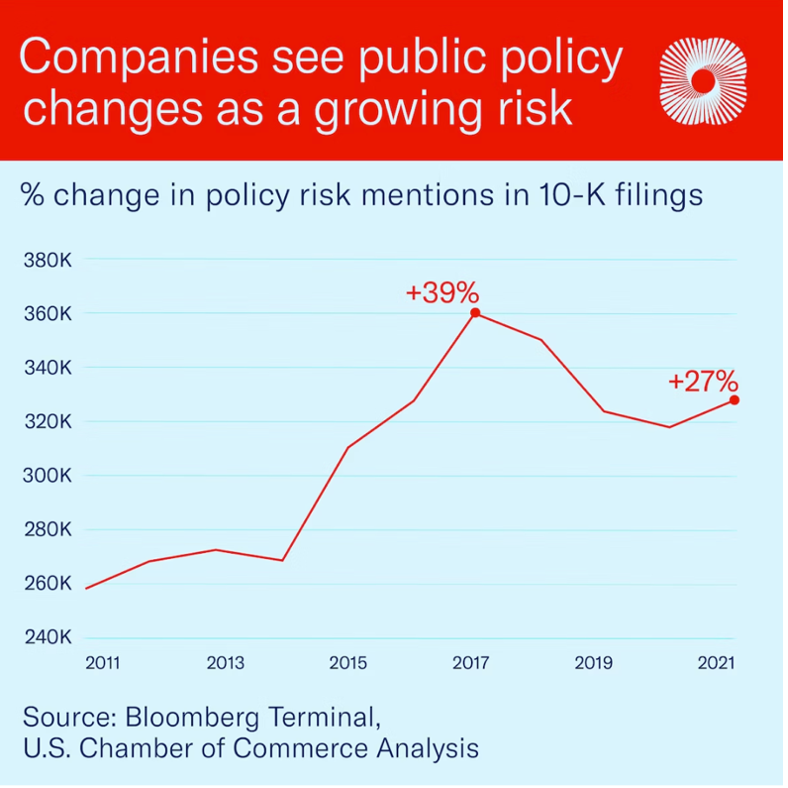
  • BULLPEN BRIEF: New Study: S&P 500 Companies’ Concerns About Public Policy Risks “Have Increased Dramatically Over The Past Decade”

    A new study conducted by the U.S. Chamber of Commerce, and covered by The Wall Street Journal last week, found that S&P 500 companies now report government policies and regulations pose a far greater threat to how corporations conduct their business compared to a decade ago.

    For the study, the Chamber reviewed a decade (2011-2021) of 10-K filings (comprehensive reports filed annually by publicly traded U.S. companies) from companies listed on the S&P 500. The review found that these companies mentioned how government actions pose a potential risk to their business about 325,000 times in 2021 – a 27 percent increase over 2011. As the report reads:

    “According to data in publicly available reports, large publicly traded companies’ concerns about public policy risks—like changes in taxes, regulations, and enforcement—have increased dramatically over the past decade, compared to other risks. This sentiment was measured by tracking terms found in regulatory filings with the Securities and Exchange Commission (SEC).”

    The reason for this sharp increase in public policy risks? The study states that the “increasingly partisan” approach to lawmaking in Washington and “a growing willingness by both parties to pursue aggressive policy changes through regulation” – rather than legislation – are key drivers:

    “The most prominent drivers behind this significant jump in public policy risks are constant shifts in power in Washington, an increasingly partisan approach to lawmaking, and a growing willingness by both parties to pursue aggressive policy changes through regulation rather than congressional legislation.”

    At BSG, we strongly believe the best path for companies in this increasingly challenging environment is to build teams and systems to anticipate, monitor, and manage policy, political, and competitive risk on a day-to-day basis. That’s also the conclusion of the study’s authors:

    “Like other risks, companies must anticipate, monitor, manage, and, when necessary, mitigate risks posed from changes in public policy. This includes closely monitoring public policy developments, engaging with policymakers, and – as we saw for example in response to trade restrictions – adjusting their business operations.”

    ###